
by Hannah Garcia, first published July 2022, updated June 2026.
WAY-HEY, Costa Del Cardiff! If this is global warming then I say 'bring it on!'
The temperature creeps up. The Met Office issues a weather warning. The trains are cancelled. The school postpones sports day.
People around you chat about the weather- this is Britain after all. Some people are chuffed; barbecue weather! Head to Barry Island! Some people shrug it off; it’s just a heat dome, don’t worry. It’s just El Niño. Enjoy it while it lasts, it’ll be raining again soon.
Your eldery mum is in a residential home, they email you an emergency heatwave planning document. Your phone overheats and switches off in protest. It’s June and there are blackberries ripening.
And a little voice inside of you says…”none of this is normal.”
We originally wrote this blog in 2022. As we re-visit it today in 2026, June’s all-time daily record temperature forecast is about to be broken and bits of England and Wales are under a rare red warning for heat, indicating risk to life for even healthy people. Dr Akshay Deoras, University of Reading described the heat as “dangerously close to levels previously thought almost unimaginable in the UK”. What we’re experiencing now isn’t just a nice spot of summer weather.
You probably feel crappy. It’s humid too, and oppressive. You’re almost certainly sick of talking about the heat. But if there’s a bit of you whispering – or perhaps screaming – that this doesn’t feel right, then read on. Talking about climate, and helping friends and family link it to their everyday experiences, is one of the most powerful actions we can take.
In this blog we’re going to offer up some ways to use the heatwave as a jumping off point for a positive conversations about climate and nature solutions. But before we get to the ‘do’s’ let’s unpack a couple of ‘don’ts’…
Everyone hates hearing "I told you so"
There are a couple of people in my life who have consistently dismissed climate action as ‘a lot of fuss over nothing’ or a scam. When those people start kvetching that the weather has gone tits up, that their dog is suffering and their lawn had died… well I can’t deny it: there’s a bit of me that wants to say ‘I’ve been tell you this was coming for YEARS!’
But here’s the thing: can you think of a time that you responded well to someone saying ‘I told you so?’ No, me neither.
Extreme weather is scary and uncomfortable. It leads people to experience a range of emotions – fear, anxiety, guilt – so making them feel daft into the bargain is unlikely to transform them into a raging climate warrior, and more likely to make them grumpy and defensive.

What to say instead:
“It’s really shaken me seeing such extreme weather this close to home, especially as it seems to be happening so often. How are you feeling about it?”
Offer a gentle opportunity for others to acknowledge new feelings they might be experiencing or say the things that could be on their mind. And then start a conversation about solutions… see below.
OK Doomer... don't be a climate catastrophist
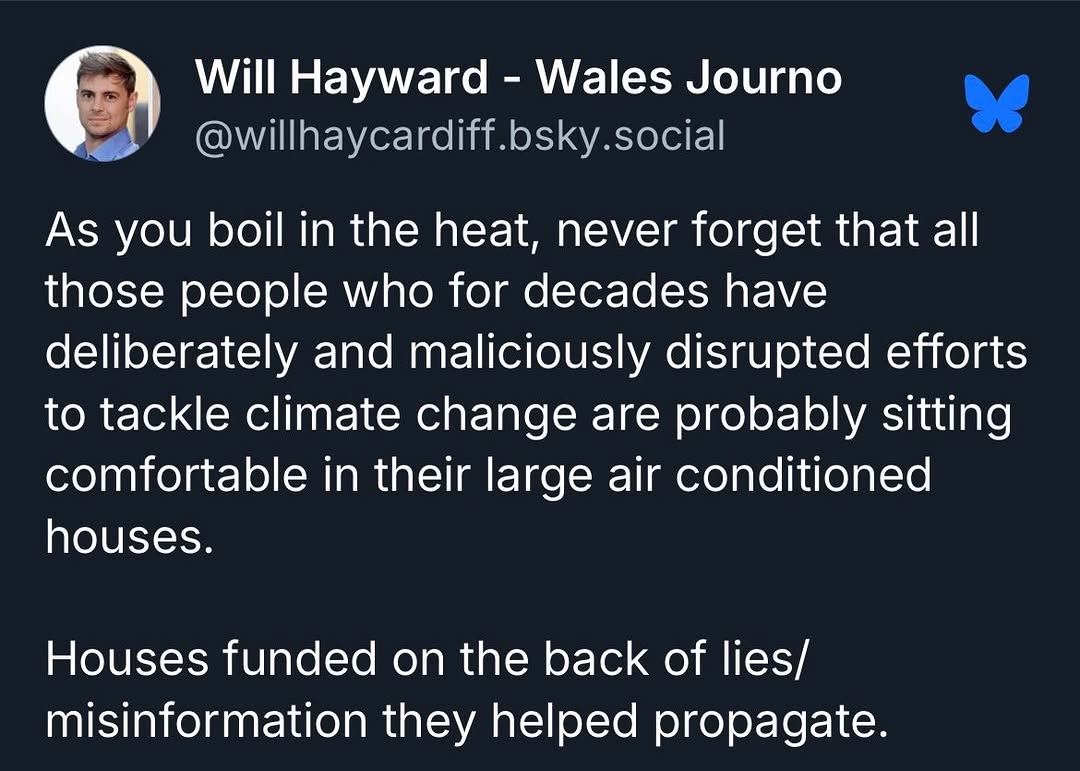
It’s so tempting to use apocalyptic words and imagery to try and shock and scare others into action, so easy to share a social media post of landscapes engulfed in wildfires and comment ‘It’s over for humans’ or simply ‘we’re f*****.”
But levels of climate anxiety are already running high, and none of us are good at making solid long term plans in a panic. Instead we’re more likely to go “I can’t cope with this right now” and chuck on a bit of Love Island. The climate movement has been relying on scare tactics for literally decade and it simply doesn’t work.
Plus, the idea that we’re past the point of no return is simply… wrong. It’s not over, we’re not doomed, and there’s LOADS we can do about it, starting right now.
What to say instead:
“Climate change isn’t an all or nothing thing and there is everything left to fight for. Plus – the solutions we need to stop this getting worse are already here, we just need to get a move on!”
Reassure the person you’re speaking with that there is still time to act, that climate action does make a difference, and then start a conversation about solutions… see below.
Three ways to have a positive conversation about climate during the heatwave
Truth be told, “I told you so” and “well, we’re doomed” are both very natural reactions to weather extremes, but there are more effective ways to draw people into the conversation. Next, let’s look at three strategies that really work.
Focus on fairness
Our society may feel very polarised right now, but recent research from More in Common suggests that we agree on more than we think: 55% of Briton say that “the differences between us are not so big that we cannot come together.” A core value that runs through most segments of British society (even if we express it in different ways) is fairness. While talk of ‘net zero targets’ or ‘reducing emissions’ may leave many people cold (or cross), discussion of unfair policies, ‘one rule for the rich’, and leaving a safe world for our children tends to unite rather than divide.
Reframing topics like energy prices, flooding, and air pollution and of course heat waves as issues of fairness can lead to really positive discussions, without the word ‘climate’ ever being uttered. Climate solutions such as insulation, renewables, and good public transport can be presented as a powerful counter to the unfairness of life in Britain today.
Thinking specifically about the heatwave, not everyone experiences it equally; it’s often the most vulnerable, and those who have done the least to cause the problem who are burdened with the impacts. What stories can we tell to encourage empathy around the heatwave?
“My nan has Alzheimer’s disease; she’s scared and uncomfortable, and I’m worried she won’t realise she’s overheating. There’s nowhere she can go to escape the heat!”
“My daughter’s school netball tournament has been cancelled because it’s not safe to play in the heat, she’s gutted.
“I can’t take the dog for a proper walk because she looks like she’s going to collapse and I’m worried about burning her paws.”
“My neighbour had her operation cancelled this morning, she’s been waiting forever. The hospital said they can’t safely operate in these temperatures.”
“It’s the farmers I feel bad for with the heat and drought – I heard about one farmer in Herefordshire losing 50% of his crop.”
“My sister in law is pregnant; she’s been told they’ll fire her if she doesn’t go into work but it doesn’t feel safe at all.”
Basing a conversation around fairness can gently question the ‘it’s just normal summer weather!’ narrative by raising empathy, but it does something else too: it helps join the dots between the climate crisis and the other areas of our lives where a lack of political leadership has left services falling apart and the most vulnerable bearing the brunt. Putting climate solutions into action (see below!) can often help fix other broken systems, from healthcare and agriculture to education and social care, creating a fairer society.
Share how you’re feeling and what you’re doing
One of the most valuable strategies in our climate conversations toolkit is our own personal perspective. If statistics and scientific predictions were enough to galvanise the changes needed then we’d have this whole thing sorted by now – but as climate comms researcher Ed Maibach tells us “On the issue of climate change, people typically trust most the people they know the best – their family members, friends, and co-workers.” Your personal story of how climate impacts like heatwaves make you feel and what you’re doing in response is powerful – much more powerful than most of us realise.
What does this look like in practice? It could be talking about how news reports of bendy train tracks and struggling wildlife make us feel – were there any details that particularly affected you? Thinking back to the 2022 heatwave, there were a couple of things I read that really stuck with me. One was a woman affected by the Wellington Fire leading horses along a road to safety after their stable burnt down, but with no idea where she was going to take them or how she was going to care for them. Another was an article describing the suffering of unhoused people in the heat.
These are stories about people, not carbon emissions, and in sharing them I add my own personal element. Reading about the woman with her horses, for example, I asked myself how I would save my own pets if my home was caught up in a wildfire. When we tell these kinds of personal responses, people listen and share some of our emotions as well as processing their own.
Another approach could be talking about the impacts you’ve witnessed directly: your baby unable to sleep in the heat, your grandfather in a sweltering nursing home bedroom, your relatives in other parts of the world forced to leave their homes due to fires. Again, these stories hit home.
Another form of personal story that really works is your journey to taking action. What are you doing, or considering doing, as a result of these experiences and emotions? Maybe you’re eating less meat, car-sharing for work, avoiding fast fashion, flying less, growing a wildlife garden, donating to a campaign group, handcuffing yourself to an oil tanker… whatever you’re doing (and whether you just started yesterday or you’ve been doing it for a decade) – talk about it. Talk about how it makes you feel to do it, and what you plan to do next. Your ability to influence change in others is a superpower.
Talk about solutions
Climate change is at our doorstep. It’s here. We no longer need to try and convince others that it’s happening, or that it’s us causing it, and we don’t need to conjure up some distant future where the impacts start to affect us. We can see it, and we don’t have time to waste, so we need a new model for our conversations, one that is grounded in how we fix this mess.
When it comes to slowing and halting climate change and nature loss there is a lot to be positive and hopeful about: we have the solutions, we just need to implement them. Climate conversations in 2026 need to be loud and proud about practical, realistic actions at every level, from individual, to community, to business, to government.
One of the easiest ways to do this is to link the solutions you talk about to your own life or the things you’re passionate about. For example…
I love to travel: chat about the personal benefits of slow travel, your own adventures, and the companies offering employees more time off to take the train instead of fly (we do this, it’s called Sustainable Travel Leave, tell your boss to sign up!). Or how about sharing the countries offering super cheap bus and rail tickets, the new cycle infrastructure in your town, or the cities rejecting cruise ships.
I love DIY: talk about the simplicity and massive cost savings of insulation, the success of other countries that have subsidised heat pumps, the feel-good factor of switching to a renewable energy supplier, the joy of buying pre-loved furniture, the wildlife that moved in since you created a pond…
I love to cook: share the interesting new ingredients and recipes you’ve tried since trying more plant-based food, the energy, cost and time savings of a slow cooker, the hilarious carrot you got in your wonky veg box, the guy at work who persuaded the company to use a plant-based caterer (and how great the food was), the letter you wrote to Tesco about their food waste, the regenerative farm you heard about on the radio…
I’m not saying we should sugar coat it of course. While the changes needed to secure a safe planet almost always bring about other benefits to health, equality, quality of life and so on, most of them bring challenges too, such as the enormous infrastructure building needed or a just transition for those working in polluting industries. But we can’t untangle these challenges unless we start talking about solutions – as Sara Peach, climate comms writers says “Talk is the fertile field in which cultural change begins; in its absence, it’s impossible for a group of people to solve a problem.”
Recent years have been tough in every sense and it is easy to think that talking about climate should wait, at least until the wars are over, our political situation settles down, the cost of living crisis is resolved – but it can’t. We’ve all got an opportunity to make an impact, today and over the coming months and years, by speaking up. We may not have chosen these roles but we are uniquely privileged to be alive and able to act in this short window of time that we have to turn things around.
So I’ll leave you with one of my favourite bits of climate wisdom from advisor Gina McCarthy: “We all have to step up… we have to act, we have to forget about the things we can’t change and we don’t like, and we have to make it the world we want. That’s it. It’s hard work. Pull up your pants and let’s go.” Or to put it another way: Have a cold shower, eat a calypo, and go tell someone about a climate solution.